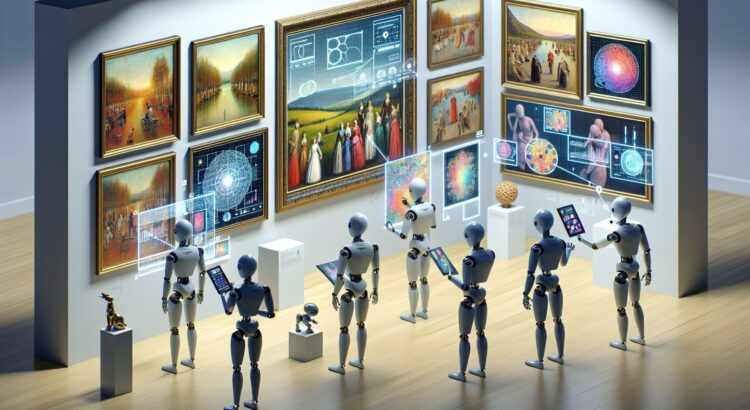
Howdy, digital amigos! Today’s diatribe dives into a delightful union between canvas and code, where art meets algorithm—Artificial Intelligence in the realm of creative arts. Let’s explore how machines are changing creativity itself as robots throw paint (or rather code) onto canvases, giving rise to an entire age of techno-artistry. Grab your digital brushes, or at least an iced coffee, and let’s wade into the creative chaos of AI and art.
The Intersection of Creativity and Computation
In the not-so-distant past, the thought of computers creating art was dismissed as somewhere between sci-fi and surreal. Fast forward to today, and we’re on the verge of giving digital Picassos a Pulitzer. But how did we get here, and why does it matter? Well, let’s break it down into bite-size bits.
A Brief History of AI in Art
Somewhere in the early 2010s, the concept of using algorithms to generate art quietly tiptoed into the creative world. It all started innocently enough, with simple generative designs that were more “Google Doodle” than “Guernica.” Fast forward a decade, and we’ve got AI-created pieces auctioned at Sotheby’s for more than my annual salary. Neural networks grew into art’s new avant-garde, making it a genuinely thrilling tech development.
Machines Making Masterpieces
So, how exactly do these digital da Vincis work? It all boils down to algorithms that’ve been fed more images than a human can view in a lifetime. By learning from these inputs, AI can generate original art. Neural networks, like Generative Adversarial Networks (GANs) that sound way scarier than they are, “learn” by doing the art equivalent of a squabble. One part designs, another critiques, until they reach a compromise.
It’s kind of like a buddy film but with less bickering and more machine learning. Don’t picture rabid robots battling, though. I already did, and it’s exactly as entertaining as you’d expect.
Robots and Renaissance: The Implications
Stepping past the initial wow factor of machine art, let’s get thoughtful here. What does AI’s entrance onto the art scene mean for the industry, for artists, and for art lovers like us?
A New Dimension of Expression
At its core, AI in art offers a bold expansion of possibilities. It allows artists, digital and otherwise, to explore territories previously limited by imagination and manual skills. With machines as their muse, creatives can probe art spaces that breathe life into new forms of expression.
Artists have teamed up with tech to produce multi-dimensional, interactive digital art exhibitions that evolve and respond to audience interaction, going beyond traditional viewing. You’ve gotta admit, that’s pretty rad!
Democratizing Artistic Creation
Another cool thing here is how AI levels the playing field. Those without the natural ability to sketch lifelike portrayals can now tap into artistic creativity through technology. It’s like a universal invite to the party where everyone gets past the velvet rope.
Picture this: art schools might one day use AI to teach aspiring artists techniques ten times faster than my latest attempt to recreate a happy little tree. It could happen!
Challenges and Controversies
But hold your horses. It’s not all smooth sailing on the seas of slick creativity. This whole scene has stirred up a paint pot of debates and challenges.
Attribution and Ownership
Once we venture down the mega-pixelated rabbit hole of originality and authorship, many questions arise. Who’s the rightful creator? Is it the programmer, the machine, or some weird mix of both? If there’s money involved, trust me, someone’s claiming it and likely arguing about it.
Copyright laws find themselves having a hefty existential crisis. Questions pop up like Whac-A-Mole about who truly “owns” an AI-generated piece, bringing tons of legal implications. Some argue for art algorithms to get recognition in their own right. Others worry we’re handing over creative freedom to the very machines we designed.
Job Security for Human Artists
In darker corners of the art scene, robots are met with digital pitchforks by folks fearing the obsolescence of the human artist. While automation has replaced many jobs, the subjective soul behind traditional art creation feels different. Most agree machines can’t replicate emotion, inspiration, or a dash of the humanity that makes art so darn great. But they can enhance it.
The Future: Painting a Picture of Possibility
Looking ahead, it’s worth embracing the possible as we sort through the pixelated pandemonium brought by AI art. Machines and humans can create stunning collaborations. Robots help artists reach previously unimaginable efficiencies and forms of beauty.
Speculating About Tomorrow
Picture a future where interactive, AI-aided art shows evolve dynamically as patrons walk through museums. Pieces that “listen” and transform based on the viewer’s emotions or reactions using sensors and sentiment recognition gadgets. We’re not there quite yet, but the stage is set for an art revolution.
As we geek out about the limitless future, let’s not forget our roots in charcoal and clay. Instead, picture them as jumping-off points for what’s possible. In this brave new art world, balance isn’t only desirable, it’s necessary.
Bringing It Home
The conversation around AI in art isn’t fading anytime soon, and I’m all for watching where it leads us! As we team up with the smart machines out there, let’s build a techno-utopia that fuses human and machine creativity in real collaboration.
So, what do you think about machines hitting the art scene? Does the idea of dynamic, intelligent, machine-generated art spark your imagination, or is it just another buzzwordy trend? Drop your thoughts in the comments, or don’t. It’s all cool. Art’s subjective after all! Until next time, enjoy the digital kaleidoscope that’s the future of creativity.