A Six-Month Race Against Genetic Darkness
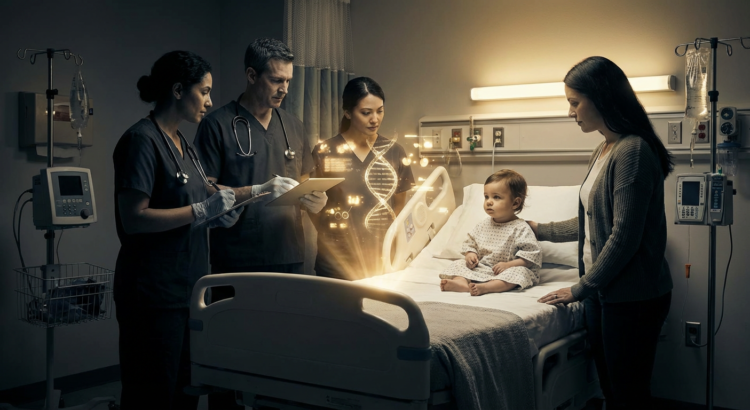
In early 2024, a toddler named KJ Muldoon was admitted to Great Ormond Street Hospital in London with a mystery. His body was drowning in ammonia, a toxic byproduct that should have been neutralized by an enzyme called carbamoyl phosphate synthetase 1, or CPS1. Except KJ had virtually none. Genetic sequencing revealed mutations in his CPS1 gene that doctors had never seen before in medical literature. He wasn’t just rare. He was undiagnosed in the truest sense — a condition so singular it had no name, no established treatment protocol, and no precedent for how to save him.
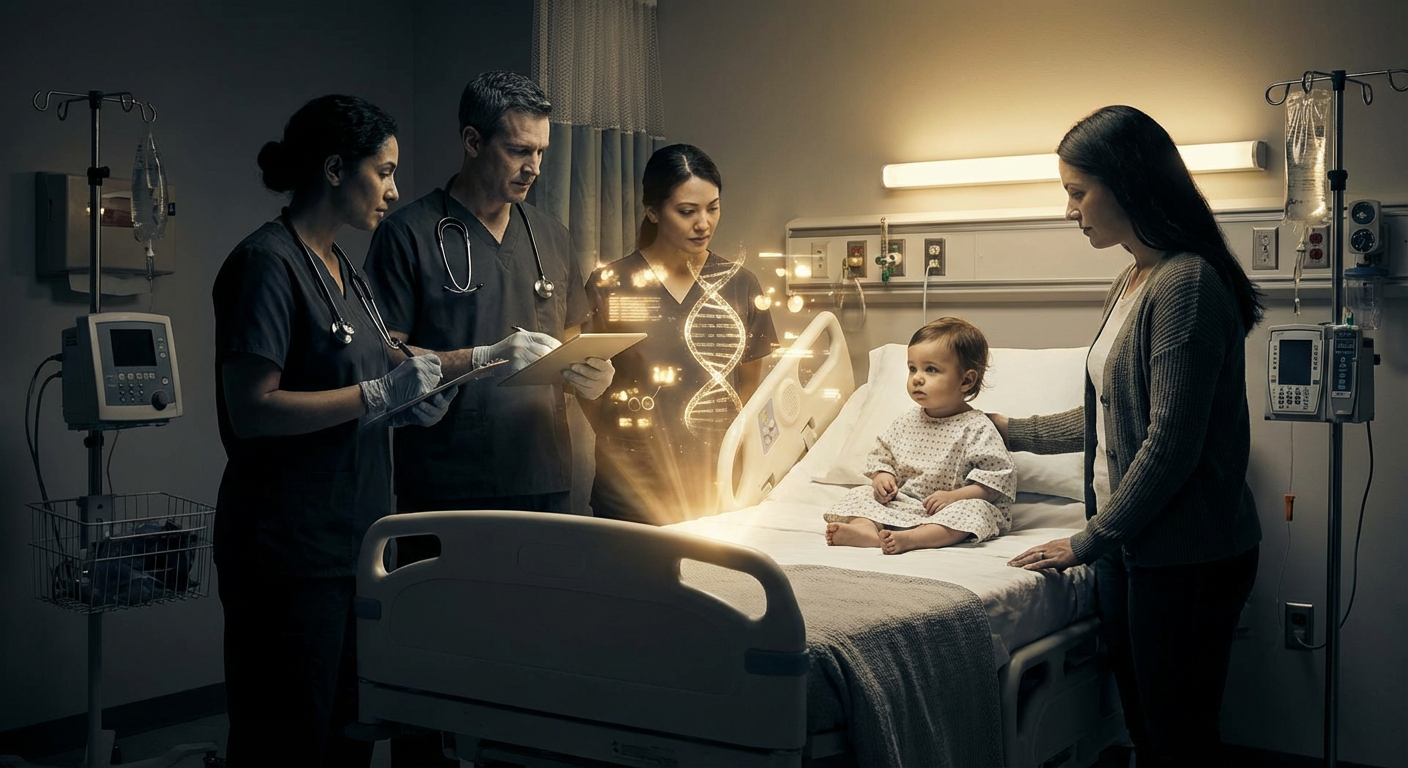
What happened next is something we genuinely haven’t seen before in human medicine. Within six months, a consortium of researchers at Great Ormond Street and the Broad Institute designed a personalized gene therapy targeting KJ’s specific mutations, manufactured it at clinical scale, and infused it into his bloodstream. Not a generic drug refined over decades. Not a therapy developed for thousands of patients. A medicine built from scratch for one child. The clinical data, published in early 2025, showed something close to normalization of his blood ammonia levels after a single treatment, with no serious adverse events at six-month follow-up.
Base Editing: The Technical Breakthrough That Made This Possible
To understand why this matters, you need to understand base editing and specifically why it’s different from the CRISPR-Cas9 approach that made gene editing famous. Traditional CRISPR works by cutting both strands of DNA at a target site, then relying on the cell’s repair machinery to either delete a faulty sequence or insert a correct one. It’s powerful but messy. Those double-strand breaks can go wrong. Off-target cuts happen. Insertions can land in unexpected places.
David Liu’s lab at the Broad Institute approached the problem differently. What if you didn’t cut at all? What if you could chemically convert one DNA letter into another while the double helix stayed intact? That’s base editing. It’s like using find-and-replace on a single letter in a massive document without rewriting the whole page. For point mutations like KJ’s CPS1 deficiency, where a single nucleotide error cascades into broken protein function, this precision matters enormously. Broad Institute Base Editing Research has spent years refining which enzymes work best, how to deliver them to target tissues, and how to minimize off-target edits. The track record is compelling enough that regulatory pathways are finally opening.
KJ’s case is the first time this technology has been deployed clinically in a living human as a fully individualized therapy. The team sequenced his mutations, designed base editors that would correct his specific genetic errors, tested the therapy in patient-derived cells to verify it worked, and then scaled it up for treatment. All within months. The NEJM — Personalized Base Editing for CPS1 Deficiency report walks through the clinical data carefully: near-normalization of ammonia levels, stable liver function, no off-target editing detected in comprehensive sequencing of treated tissue samples.
The Undiagnosed Millions Waiting in the Shadows
Here’s the part that keeps me up at night. The NIH’s Undiagnosed Diseases Program has identified over 1,000 patients since 2023 with conditions so genetically rare they affect fewer than 10 known individuals globally. Fewer than 10. That means there are hundreds of children like KJ out there right now, sick with diseases that have no names, whose mutations are so individually unique that no drug company will ever manufacture a therapy. They’re orphans not just clinically but genetically.
For most of medical history, these patients had no good options. Pharmaceutical development requires populations large enough to fund trials, generate revenue, justify R&D costs. A disease affecting three people on Earth doesn’t meet that threshold. It never will. But personalized gene therapy inverts the economics entirely. If you can design a treatment for one person in six months, the question stops being “is this commercially viable?” and starts being “can we afford not to do it?” That reframing is genuinely significant. The rarest genetic diseases stop being death sentences by default. They become engineering problems.
The population waiting is enormous. Rare genetic diseases collectively affect roughly 10% of the global population. The vast majority of those people have conditions so specific, so individually varied through multiple mutations, that they’ll never fit into a clinical trial cohort. They’re the exact use case for bespoke medicine. KJ’s case isn’t just about saving one child. It’s proof that the infrastructure, the regulatory framework, and the scientific tools now exist to help all of them.
The Economics of Building Medicine for One Person
There’s a brutal honesty we need to sit with here. Producing a single individualized CRISPR base-editing therapy currently costs somewhere between 500,000 and 2 million dollars. Per patient. For a one-time treatment targeting one individual’s unique mutations. The number sounds obscene until you compare it to the cost of lifelong management of untreatable genetic disease: decades of hospitalization, dialysis, organ transplants, or simply watching a child die. Viewed against that backdrop, the math becomes less clear-cut.
Where it gets interesting is the trajectory researchers are predicting. Nobody is proposing we keep paying this much forever. The hypothesis is that modular delivery platforms, systems that mix and match therapeutic components to target different genes while using the same basic infrastructure, could reduce per-patient costs by 90% within a decade through economies of scale. You standardize the manufacturing, the quality control, the regulatory pathways. You turn bespoke medicine into semi-modular medicine, building a platform optimized for rare diseases the way pharmaceutical companies have built platforms optimized for common ones.
The insurance and healthcare policy questions are thornier. Which patients get access first? How do we prevent a two-tiered system where wealthy families can afford personalized cures while others can’t? These aren’t problems we can solve in a lab. They’re policy problems, ethical problems, economic problems that require input from outside science entirely. But they’re not new either. They’re the same questions we’ve been wrestling with for decades around access to cutting-edge treatments. The difference is that now we actually have the tools to make the treatment possible in the first place.
What This Moment Really Means
KJ Muldoon’s case is being framed in headlines as “first personalized CRISPR cure” and “genetic disease solved.” Both are true but incomplete. The more accurate framing is this: we’ve just demonstrated that individualized gene therapy can be designed, manufactured, and deployed clinically within months, targeting a mutation so rare it had never been treated before, with results good enough to show meaningful restoration of organ function. That’s not hype. That’s a real shift in what medicine can do.
Personalized medicine has been a theoretical future for a long time. It’s now an actual option for the people most desperate for it. The rarest genetic diseases, the ones that have always fallen through the cracks of pharmaceutical development, are suddenly addressable. The technologies are mature enough. The costs are coming down. The regulatory pathways are opening. The only question is whether we build the infrastructure and make the policy choices to make this routine rather than exceptional.
I’m genuinely curious what you think happens next. Do we see other base-editing therapies follow KJ’s path? How quickly do we move from one case to dozens to hundreds? What happens to the economics as manufacturing scales? What ethical frameworks do we need to put in place? If you’ve been following rare genetic disease research or thinking about where gene therapy actually goes from here, I’d love to hear your thoughts in the comments. The science is moving faster than most people realize, and the implications deserve serious conversation.