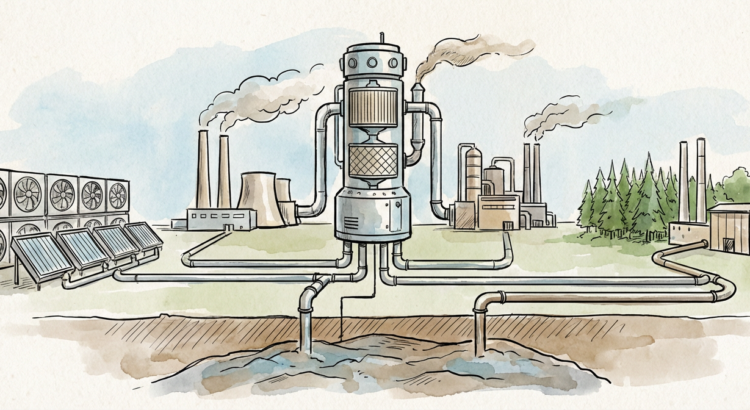
The Engineering Reality Behind Today’s Carbon Capture Surge
The headlines about carbon capture often focus on massive industrial installations pulling CO2 from smokestacks, but the real revolution is happening at the molecular level. Direct air capture facilities like Climeworks’ Orca plant in Iceland are grabbing attention with their 4,000-ton annual capacity, yet the breakthrough isn’t in scale. It’s in the fundamental chemistry that makes selective CO2 absorption possible at atmospheric concentrations of just 420 parts per million.
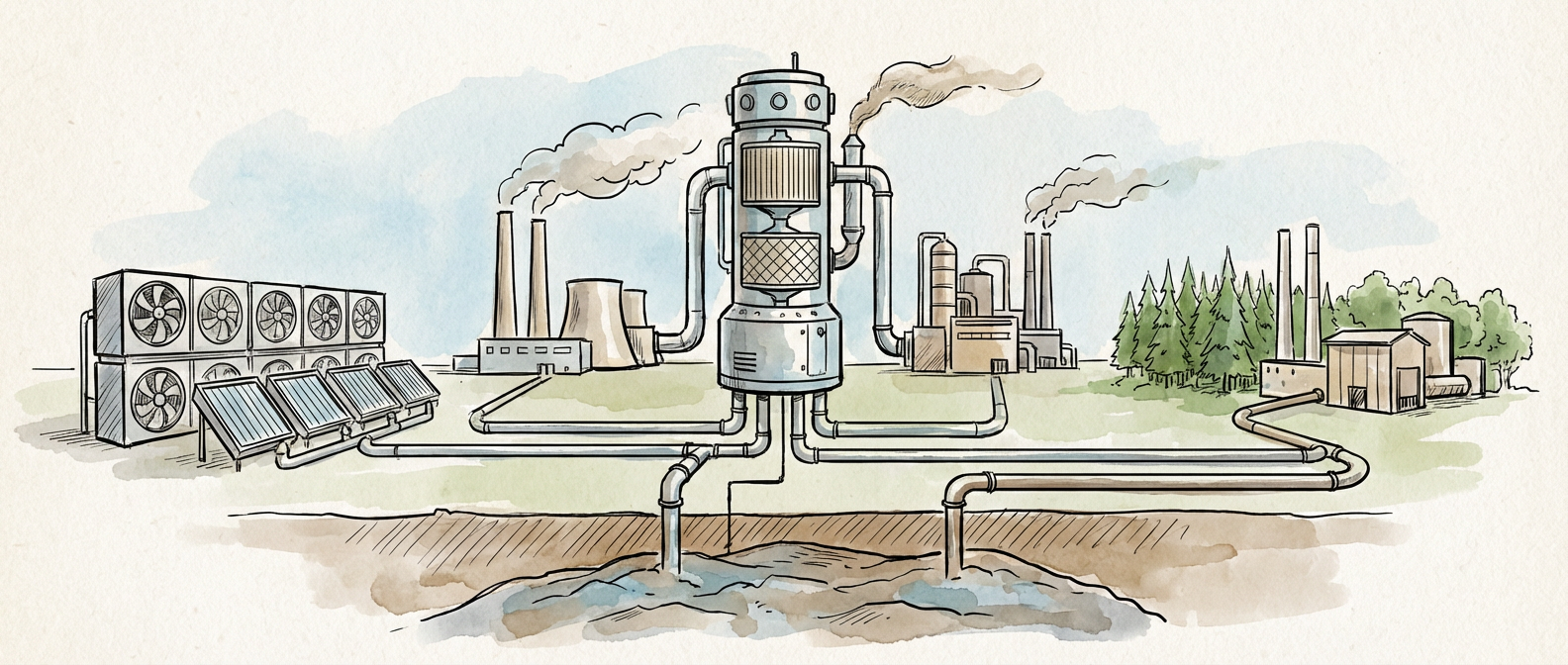
Metal-organic frameworks, or MOFs, are at the cutting edge of this selectivity challenge. These crystalline structures contain metal ions connected by organic linkers, creating precisely tuned pore sizes that can distinguish CO2 molecules from nitrogen, water vapor, and other atmospheric components. Recent work from UC Berkeley demonstrates MOFs with CO2 uptake capacities exceeding 6 millimoles per gram under ambient conditions. But the real breakthrough lies in their reversibility. These materials can release captured CO2 with minimal energy input, sometimes just a temperature swing of 40-60 degrees Celsius, making the capture-release cycle economically viable.
What excites me most about current MOF research is how it’s solving the regeneration energy penalty that has plagued carbon capture for decades. Traditional amine-based sorbents require substantial heat to release CO2, often consuming 25-30% of a power plant’s output. The newest MOF designs, particularly those with flexible frameworks that physically contract when CO2 is removed, are approaching theoretical minimum energy requirements for the separation process.

The Chemistry Revolution: From Waste Disposal to Resource Generation
Here’s where carbon capture technology starts looking less like environmental cleanup and more like industrial transformation. The CO2 captured by these advanced systems isn’t headed for underground storage. It’s becoming the feedstock for an entirely new category of manufacturing processes. Electrochemical CO2 reduction, powered by renewable electricity, can convert atmospheric carbon dioxide directly into ethylene, methanol, and even jet fuel.
The efficiency gains in CO2 electroreduction over the past five years have been staggering. Copper-based catalysts that achieve 60-70% selectivity for multi-carbon products like ethylene are moving from laboratory demonstrations to pilot-scale systems. More intriguingly, tandem catalyst designs that couple CO2 reduction with water oxidation are achieving energy efficiencies that approach what would be economically competitive with fossil fuel-derived chemicals, assuming continued decreases in renewable electricity costs.
The second-order implications here deserve serious consideration. If we can manufacture commodity chemicals from atmospheric CO2 using renewable electricity, we’re doing more than creating a carbon-neutral industrial process. We’re potentially creating a carbon-negative one. Every kilogram of ethylene produced from captured CO2 is roughly 1.57 kilograms of atmospheric carbon converted into useful products rather than being emitted from petroleum cracking.
The Infrastructure Cascade: When Carbon Becomes Currency
This shift toward CO2 utilization rather than simple storage triggers a fascinating infrastructure evolution. Traditional carbon capture projects require massive pipeline networks to transport CO2 to geological storage sites, an expensive proposition that has limited deployment to regions with suitable underground formations. But when CO2 becomes a valuable industrial input, the economic geography completely changes.
Consider what happens when steel plants, cement manufacturers, and chemical refineries begin treating atmospheric CO2 as a raw material rather than a waste product. The optimal locations for these facilities shift from proximity to fossil fuel sources toward areas with abundant renewable electricity and appropriate CO2 concentrations. This isn’t speculative futurism. Companies like Carbon Engineering are already planning integrated facilities that capture CO2 directly from air and convert it to synthetic fuels on-site.
The transportation infrastructure implications are equally profound. Instead of building pipelines to carry CO2 away from industrial centers for storage, we might see networks designed to distribute captured CO2 to facilities that can utilize it. This reversal creates entirely different economic incentives for carbon capture deployment and could accelerate adoption in regions where geological storage isn’t feasible.
The energy storage potential of this infrastructure cascade shouldn’t be overlooked either. CO2-derived methanol and synthetic hydrocarbons can work as long-term energy storage media, converting excess renewable electricity into chemical bonds that can be released when needed. This creates a direct link between carbon capture technology and grid-scale energy storage, two of the most critical challenges in renewable energy deployment.
Timeline Realities: Distinguishing Laboratory Promise from Commercial Deployment
The enthusiasm around these developments needs tempering with realistic timelines and technical constraints. While MOF-based direct air capture shows impressive performance in laboratory settings, the path to gigaton-scale deployment faces significant materials science challenges. The most promising MOF structures require exotic metal centers or complex organic synthesis that would be prohibitively expensive at industrial scales.
Electrochemical CO2 conversion faces its own scalability hurdles. The copper catalysts showing excellent selectivity in research settings typically degrade within hundreds of hours of operation because of surface oxidation and structural changes. Industrial chemical processes require catalyst lifetimes measured in years, not months. Recent work on single-atom catalysts and oxide-derived copper surfaces is promising, but we’re likely looking at 5-8 years before these systems achieve the stability needed for commercial deployment.
More pragmatically, the economics of CO2 utilization depend heavily on carbon pricing mechanisms and fossil fuel costs. Current pilot projects demonstrate technical feasibility, but economic competitiveness requires either carbon taxes in the $100-150 per ton range or substantial continued decreases in renewable electricity costs. Neither is impossible, but both depend on policy and market developments beyond the control of technology developers.
The Convergence Point: Where Climate Technology Meets Industrial Revolution
What makes this technological moment particularly compelling is how carbon capture innovations are converging with advances in renewable energy, materials science, and industrial automation. The combination of increasingly cheap renewable electricity, precisely engineered MOF materials, and robust CO2 conversion catalysts creates the possibility of carbon-negative industrial processes at scales that could genuinely impact atmospheric composition.
The near-term trajectory, the next 3-5 years, will likely see continued improvements in direct air capture efficiency and the first commercial-scale CO2 utilization facilities producing specialty chemicals and fuels. These early projects will establish the technical precedent and economic framework for larger deployments. The medium-term trajectory, 5-15 years, could see carbon capture and utilization becoming standard components of industrial infrastructure, particularly in regions with aggressive climate policies and cheap renewable energy.
The longer-term implications stretch into genuinely transformative territory. If atmospheric CO2 becomes a primary feedstock for industrial chemistry, the carbon cycle itself becomes a managed system rather than an environmental constraint. We’re potentially looking at the emergence of a circular carbon economy where atmospheric composition is actively regulated through industrial processes rather than just emission reductions.
The research papers arriving weekly in journals like Nature Energy and Science continue pushing these technological boundaries forward, each study adding another piece to what might become a fundamentally different relationship between human industry and atmospheric chemistry. The question isn’t whether these technologies will work. The question is how quickly they can scale and what industrial landscape they’ll create along the way.