The Messy Business of Making Space Accessible
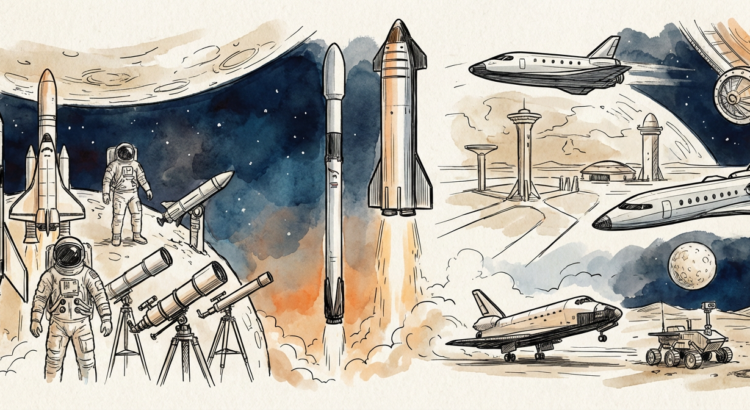
SpaceX’s Starship program is the perfect example of how messy commercial spaceflight really gets. After multiple explosive test flights that sent debris raining across Texas beaches, the massive rocket finally achieved orbital flight capabilities and now carries commercial payloads. Here’s what those explosions taught us: breakthrough innovation means spectacular failures aren’t obstacles—they’re required reading.

Traditional aerospace spent decades on exhaustive ground testing and conservative timelines. New commercial space companies borrowed Silicon Valley’s playbook instead: fail fast, learn faster, iterate continuously. At first, this looked reckless to traditional aerospace engineers. But it’s cut development cycles from decades to years while slashing costs.
Critics pointed to early Starship explosions as evidence of dangerous corner-cutting. Fair enough. But these visible failures hid sophisticated data collection efforts. Each explosion provided terabytes of real-world performance data that no computer simulation could replicate. The willingness to accept public failure to achieve rapid iteration has completely changed how we develop space technology, though it’s generated plenty of controversy and regulatory headaches along the way.
Government Programs Grappling with Commercial Reality
NASA’s Artemis program, aiming to return humans to the lunar surface between 2026 and 2027, is a fascinating hybrid of traditional government oversight and commercial innovation. The program relies heavily on commercial partners while maintaining the risk-averse culture that has long characterized government space missions. This creates inevitable friction between rapid commercial development cycles and methodical government validation processes.
The challenge gets particularly tricky when commercial failures hit government timelines. When SpaceX’s early Starship tests exploded, they didn’t just delay commercial objectives—they potentially impacted Artemis scheduling. Government programs must now account for commercial development uncertainty while maintaining public confidence in mission safety and timeline commitments.
This has forced NASA to develop new risk management frameworks that acknowledge commercial iteration cycles while protecting astronaut safety. NASA news frequently highlights this balancing act between innovation speed and safety validation, revealing the learning curve required when traditional agencies work with commercial disruptors.
Infrastructure Development and Its Inevitable Setbacks
Commercial space station development through companies like Axiom Space and Blue Origin is another area where ambitious timelines meet complex realities. These companies received significant NASA contracts to develop replacements for the International Space Station. Early progress has revealed the immense challenges of creating habitable space environments from scratch. Initial design reviews uncovered fundamental issues requiring complete system redesigns, pushing timelines well beyond original projections.
The regulatory environment adds more complexity. Asteroid mining frameworks under development at the United Nations level attempt to establish property rights and operational protocols for an industry that barely exists. Meanwhile, mandatory space debris mitigation rules for new satellite operators create compliance costs that many startups struggle to handle. These regulatory developments are necessary for long-term sustainability, but they inevitably slow commercial development and increase operational complexity.
Industry publications like Space News industry regularly document how these regulatory requirements force companies to redesign missions, alter satellite configurations, and implement tracking systems that eat up significant portions of development budgets. Creating workable regulations for unprecedented activities requires constant adjustment as new technical capabilities emerge.
Economic Projections Versus Market Development Reality
Projections suggesting a lunar economy worth $170 billion by 2040 reflect tremendous optimism about commercial space development, yet current market realities suggest a more complex path forward. These projections assume rapid development of lunar infrastructure, reliable transportation systems, and profitable commercial activities beyond government contracts. Each assumption carries significant technical and economic risks that current development timelines struggle to address.
The satellite internet market provides useful context about the gap between projections and reality. Multiple companies launched ambitious constellation plans with aggressive timelines. Technical challenges, regulatory hurdles, and market development difficulties have delayed profitability for most operators. Similar challenges await lunar commercial development, where transportation costs, life support systems, and resource extraction technologies remain largely unproven at commercial scales.
The learning process means acknowledging that economic projections often underestimate development complexity while overestimating market demand timelines. Companies that recognize this reality and build adaptive business models around iterative development cycles position themselves better for long-term success than those committed to rigid timeline projections.
Embracing Uncertainty as Competitive Advantage
The most successful commercial space companies have learned to treat uncertainty and failure as competitive advantages rather than obstacles. This mindset shift enables rapid experimentation with novel technologies, business models, and operational approaches that traditional aerospace companies cannot easily replicate because of institutional risk aversion and stakeholder expectations.
Companies like SpaceX have proven that public failure tolerance, combined with systematic learning from setbacks, accelerates overall development progress despite individual project failures. This approach requires sophisticated data collection capabilities, rapid analysis cycles, and organizational cultures that reward learning from failure rather than punishing unsuccessful outcomes.
The broader commercial space industry now faces a critical point where early adopters of this experimental mindset gain significant advantages over competitors committed to traditional development approaches. Companies that successfully balance rapid iteration with safety requirements while managing stakeholder expectations around inevitable setbacks will likely dominate emerging space markets.
The future of commercial spaceflight depends not on eliminating failures but on developing better systems for learning from them quickly and systematically. As this industry matures, our understanding of space development challenges will improve, but the fundamental requirement for experimental thinking and failure tolerance will remain central to continued progress. What aspects of commercial space development do you find most intriguing or concerning as we navigate this unprecedented expansion beyond Earth?