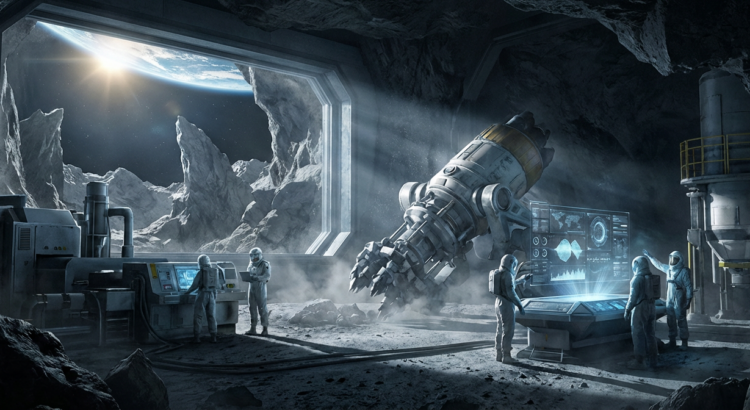
When a Pebble Contains More Platinum Than Earth
Picture this: you’re holding a rock the size of a football stadium. Sounds manageable, right? Now imagine that rock contains more platinum than has ever been mined in human history. Welcome to the mind-bending world of asteroid mining feasibility studies, where our intuitive grasp of scale becomes beautifully, hopelessly inadequate.
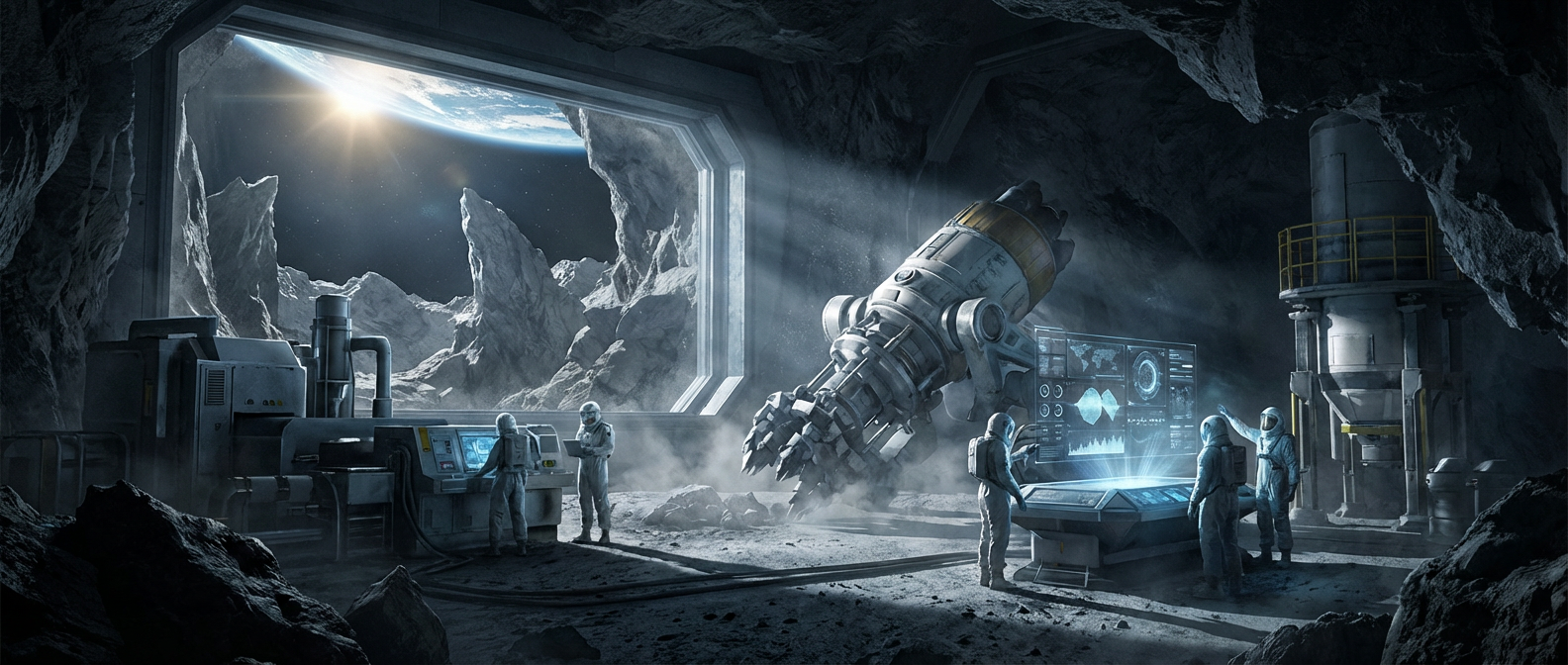
The asteroid 16 Psyche is currently NASA’s target for an ambitious mission launching this decade. It measures roughly 280 kilometers across. If you dropped it over New York City, it would stretch from Manhattan past Albany. But here’s where scale gets truly weird: early spectroscopic analysis suggests this single asteroid contains enough iron, nickel, and precious metals to crash every metal market on Earth at once. We’re talking about resource concentrations so massive that they flip our understanding of scarcity economics on its head.
Planetary scientists at Arizona State University estimate that 16 Psyche alone holds $10,000 quadrillion worth of metals. Let me write that out: $10,000,000,000,000,000,000. That number is so absurd it stops meaning anything. Which is exactly the scale problem that makes asteroid mining both incredibly promising and dizzyingly hard to wrap your head around.

The Energy Equation: Moving Mountains in a Vacuum
Before we start planning our retirements on asteroid platinum fortunes, let’s face the brutal physics. This is where feasibility studies get uncomfortably honest about energy requirements. Extracting and returning just 1,000 tons of platinum from a near-Earth asteroid needs energy that makes launching the International Space Station look like tossing a paper airplane.
Take delta-v requirements. Delta-v is the change in velocity needed for spacecraft maneuvers, basically the currency of space travel. A mission to mine asteroid 433 Eros (one of the easier targets) needs about 12-15 km/s of delta-v for a round trip. Escaping Earth’s gravity well? About 11 km/s. We’re talking about launching a mining operation that needs more energy than leaving Earth, then somehow dragging tons of processed material back through the same gravitational obstacle course.
Current ion propulsion systems produce thrust measured in pounds when we need capabilities measured in tons. The mismatch is like trying to move a cruise ship with a desk fan. Recent studies from MIT’s Aerospace Engineering department suggest fusion-powered spacecraft could theoretically bridge this gap. But fusion spacecraft remain stubbornly just beyond our reach.
The Infrastructure Paradox: Building Cities to Mine Rocks
Here’s where the scale problem gets almost laughably obvious. Every serious feasibility study for asteroid mining reaches the same conclusion: successful operations need infrastructure so extensive that we basically have to build floating cities in space before we can extract the first gram of platinum.
Think about terrestrial mining. A single copper mine needs massive earthmoving equipment, processing facilities, power plants, transportation networks, and thousands of workers. Now imagine rebuilding that entire industrial ecosystem in the vacuum of space, 150 million kilometers from the nearest hardware store. The European Space Agency’s recent white paper estimates that a minimal asteroid mining operation would need at least 50 launches of Saturn V-class rockets just to deliver basic equipment.
But the scale cuts both ways. While the infrastructure requirements seem impossibly huge, the potential returns operate on similar scales. A single metallic asteroid holds enough raw materials to build space habitats for millions of people. We’re not just mining rocks. We’re potentially accessing materials to build humanity’s expansion into the solar system. Suddenly, that infrastructure investment looks less crazy when you see it as the foundation for an entire space-based civilization.
Time Horizons That Humble Human Planning
Most feasibility studies work with investment timescales of 5 to 20 years. Asteroid mining studies routinely discuss development timelines spanning 50 to 100 years. This isn’t pessimism. It’s honest acknowledgment of scale realities that dwarf normal project planning.
The Japanese Hayabusa missions give us our best real-world data for asteroid operations. Hayabusa2 took six years to collect a few grams of material from asteroid Ryugu. Scaling that mission to extract meaningful commercial quantities needs technological breakthroughs across multiple fields at once: robotics, artificial intelligence, space manufacturing, closed-loop life support, and autonomous mining equipment that can work reliably for decades without human help.
What makes these timelines particularly interesting is how they sync with technological development curves. MIT economist Andrew McAfee’s analysis suggests asteroid mining becomes economically viable right when Earth-based rare metal supplies get critically tight. The scale of asteroid resources means we’re racing against terrestrial depletion, with the finish line measured in geological time rather than fiscal quarters.
The Beautiful Impossibility of Scale
Maybe the most delightful thing about asteroid mining feasibility studies is how they force us to think beyond every scale we’re built to handle. We evolved to track small groups across limited territories. Now we’re trying to plan industrial operations across interplanetary distances using resources measured in quadrillions.
Recent modeling by researchers at the Colorado School of Mines suggests successful asteroid mining operations will need artificial intelligence systems capable of autonomous decisions across time delays measured in light-minutes. We’re not just engineering mining equipment. We’re creating robotic civilizations that can think and act independently across scales of space and time that make human oversight impossible.
The scale problem in asteroid mining isn’t an obstacle to overcome. It’s a window into humanity’s potential future as a spacefaring species. Every feasibility study concludes that while asteroid mining remains technically challenging and economically uncertain, the sheer magnitude of available resources makes continued research not just worthwhile, but necessary for long-term human prosperity.
What aspects of the asteroid mining scale problem grab your imagination most? I’d love to hear your thoughts on whether you think we’re decades or centuries away from seeing the first commercial asteroid mining operations, and what technological breakthroughs might dramatically speed up these timelines.