The Milestone Nobody Wanted
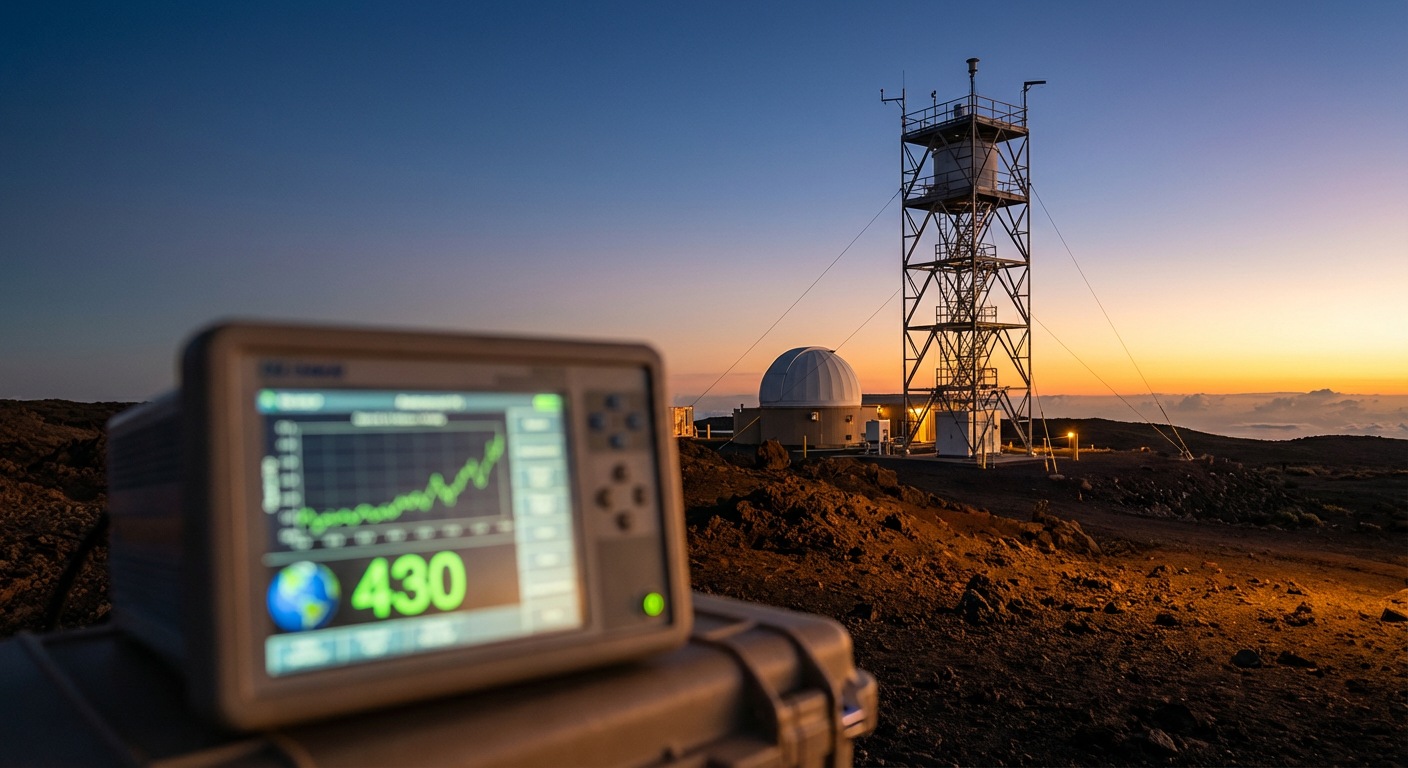
It happened quietly. In May 2025, atmospheric CO2 at the Mauna Loa Observatory crossed 430 parts per million for the first time in recorded history. No alarm bells rang at the summit of that Hawaiian volcano. No news helicopters circled. The measurement simply joined thousands of others in a dataset that has been accumulating, month by month, since 1958, when Dave Keeling first decided to climb that mountain and start counting molecules. The NOAA Global Monitoring Laboratory – Mauna Loa CO2 Data confirms it now, entered into history like every other inconvenient number before it.

What strikes me about this moment isn’t the milestone itself, but what it represents in the grammar of science. We failed. Not spectacularly. Not completely. But in a way that matters. Our models told us we would stabilize. Our policies assumed we would reduce. Our best efforts suggested we might bend the curve downward. Instead, atmospheric CO2 keeps rising, and it’s rising faster than many of us predicted. This is science doing what science is supposed to do: catching us being wrong and demanding we adjust.
The Acceleration Nobody Predicted Correctly
Here is where the humility becomes required reading. Over the past decade, the annual increase in atmospheric CO2 has averaged 2.4 parts per million per year. That might sound small, abstract, harmless. Compare it to the 1990s, when the annual increase averaged 1.6 ppm per year. We are not merely continuing on the same trajectory. We are accelerating. The slope of the line is getting steeper. The Keeling Curve, that faithful record maintained by Scripps Institution of Oceanography for sixty-seven years, tells a story of emissions that are not stabilizing but intensifying.
This is the point where many people expect scientists to panic, to revise everything downward, to declare that civilization is doomed. Some do that. I understand the impulse. But the more honest response is to acknowledge what this acceleration actually means: our previous estimates of how quickly we would address climate change were optimistic. We overestimated the speed of energy transition. We underestimated global energy demand. We misjudged the political economy of fossil fuel infrastructure. These are not failures of climate science. They are failures of implementation, policy, and collective will. Climate science simply measured the gap between what we said we would do and what we actually did.
When Models Meet Reality: The 40 Percent Problem
But there is another kind of failure happening too, and this one lives inside the models themselves. In January 2025, researchers published findings in Nature Climate Change that rattled through the climate community like a very polite but very serious alarm. The models we have been using to project future warming, the ones that inform international agreements and policy frameworks, underestimated Arctic permafrost carbon release by approximately 40 percent. Let that sink in. Not a small correction. Not a minor adjustment. A massive revision to one of the climate system’s most dangerous feedback mechanisms.
Permafrost is not just frozen ground. It is a carbon vault containing organic matter accumulated over millennia. As Arctic temperatures rise, that vault opens. The carbon escapes as methane and CO2. The warming accelerates. This is a feedback loop, and we designed our models with it included, but we did not design it correctly. The new research suggests those models are missing something fundamental about how quickly and completely that carbon will be released. The implication is brutal: current projections may underestimate future warming by an additional 0.3 degrees Celsius from this mechanism alone. That is not nothing. That is the difference between barely holding the line and watching it dissolve.
The Year the Target Became Yesterday’s News
Last January, the Copernicus Climate Change Service – 2024 Annual Report confirmed something we knew was coming but had not yet officially confirmed. The year 2024 became the first calendar year in recorded history to exceed 1.5 degrees Celsius above pre-industrial averages globally. This was not a monthly anomaly. This was not a temporary excursion. This was a full calendar year. The Paris Agreement’s aspirational temperature limit, the one negotiated in 2015 with such ceremony and hope, is now something we are exceeding on an annual basis.
What does it mean that our aspirational target is now our historical baseline? It means we have entered a different phase of this crisis. We are no longer debating whether we will exceed 1.5 degrees. We have already exceeded it. We are now debating whether we will stay there or continue warming beyond 2 degrees. That is the new argument, and it is a fundamentally different conversation than the one we were having five years ago. Scientists predicted this would happen. We were not wrong about the trajectory. But there is a world of difference between predicting something and living through it.
What Failure Teaches Us
I say all this because scientific failure matters, and it is increasingly important to discuss openly. When a model is wrong, when our predictions miss their mark, when reality accelerates past our expectations, this is not a reason to dismiss science. It is a reason to trust it more. Science that never failed would be faith, not knowledge. Science that could not accommodate being wrong would be dogma, not methodology. The climate models that underestimated permafrost carbon release can be corrected. The emissions projections that fell short can be updated. The frameworks that assumed policy would follow physics can be rebuilt with more realistic assumptions about human behavior.
The Keeling Curve continues. The measurements continue. The data keeps accumulating at Mauna Loa, month after month, year after year. That dataset is the longest continuous measurement of atmospheric CO2 we have, and it remains the gold standard against which all other measurements are checked. Sixty-seven years of data collection by thousands of researchers, maintained through funding cycles and political changes and shifting attention. This is what science looks like when it works: patient, careful, willing to revise, and fundamentally committed to knowing reality as it actually is rather than as we wish it to be.
What are your thoughts on how we should interpret these inflection points? What aspects of climate modeling uncertainty concern you most? I’m genuinely curious how you are processing this cascade of failed predictions and adjusted timelines.