
The Moment Everything Shifted
When the Europa Clipper slipped within 25 kilometers of Europa’s frozen crust in late 2025, something unexpected happened. The spacecraft’s instruments did not merely confirm what we suspected. They revealed a chemical story so layered with possibility that the entire field of ocean world habitability is now recalibrating its baseline assumptions. This was not a gentle correction to existing models. Researchers were forced to confront how much they had been glossing over in their preliminary theories.

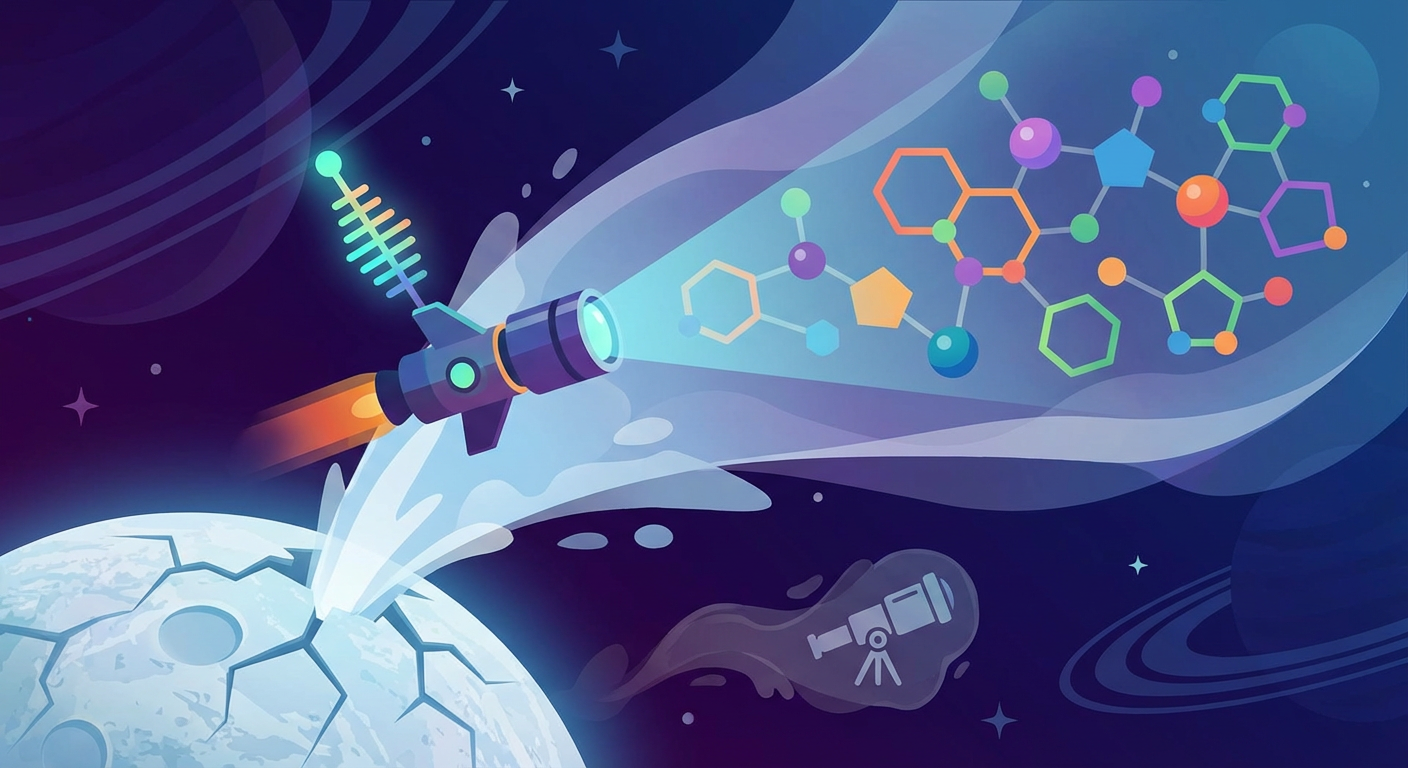
The key revelation came from the spacecraft’s mass spectrometer as it sampled material ejected from Europa’s subsurface plumes. The detection of complex carbon-bearing compounds—organic molecules far more sophisticated than the simple signatures Hubble hinted at back in 2018—is a watershed moment for astrobiology. We knew plumes existed. We suspected they carried chemistry worth studying. What nobody fully anticipated was the sheer molecular complexity waiting in those ejecta samples.
What the Plumes Are Actually Telling Us
Here is where precision matters. The 2018 Hubble observations caught glimpses of water vapor plumes; tantalizing, but limited in what they could reveal about composition. The Europa Clipper’s instruments, by contrast, are engineered specifically to decode the chemical alphabet of these plumes. The mass spectrometer signatures suggest organic chemistry far more elaborate than simple hydrocarbons. We are talking about compounds that, on Earth, would suggest biological or prebiological chemical networks.
The constraint here is critical: detecting organic molecules does not mean detecting life. It means detecting the chemical substrate upon which life could potentially operate. These compounds could form through purely abiotic processes—radiation chemistry, thermal decomposition, or reactions at hydrothermal vent interfaces. What makes this finding important is not that it proves life exists beneath Europa’s ice, but that it proves the chemical preconditions for life are being actively synthesized and transported from the subsurface to space where our instruments can reach them.
This connects directly to what we know about Europa’s ocean itself. Current modeling from JPL, published in 2024, estimates the subsurface ocean contains roughly twice the volume of all Earth’s oceans combined. That is not merely a large reservoir. That is a planetary-scale aquatic system with habitability implications that are genuinely hard to wrap your head around. The Clipper mission data now suggests this ocean is not chemically static or sterile. It is chemically dynamic, churning with processes that generate the very compounds we detected in the plumes.
The Ice-Penetrating Window into a Hidden World
The REASON ice-penetrating radar aboard the Clipper is one of the most sophisticated tools we have ever aimed at an extraterrestrial body. This instrument can probe up to 30 kilometers beneath Europa’s icy surface, which means it can theoretically map the structure of the ice shell itself and detect subsurface liquid features that might otherwise remain invisible. During this first flyby, preliminary REASON data suggested the ice shell is even more fractured and dynamic than models had predicted.
What does a fractured ice shell mean? It means plumbing—literal pathways through which subsurface material can reach the surface. It means the boundary between Europa’s hidden ocean and its visible face is more porous, more interconnected, than we had assumed. The radar data is still being processed, and specific claims require caution, but the texture of what we are seeing points toward a world where isolation is not the default condition. Connectivity is.
This is where things get genuinely interesting. The Clipper carries nine science instruments total, and they work together in ways that create a much richer picture than any single measurement could provide. The combination of plume chemistry, radar imaging, and surface composition analysis builds a convergent narrative about Europa as a geologically active, chemically complex world.
Hydrothermal Vents and the Possibility of Life
Europa’s ocean floor almost certainly hosts hydrothermal activity similar to the vent systems that cover Earth’s deep seafloor. This is not speculation. It emerges from thermal modeling, from compositional analysis of Europa’s interior, and from our understanding of tidal heating. A 2025 Nature Geoscience review examining ocean world habitability reinforces what deep-sea biologists have known for decades: hydrothermal vents on Earth support entire ecosystems independent of sunlight, powered instead by chemical energy. The same principles would apply beneath Europa’s ice.
What makes this relevant to the Clipper’s findings is straightforward: if Europa’s vents are generating the organic compounds we detected in the plumes, then the habitability picture shifts dramatically. We are not looking at a barren subsurface ocean with scattered chemical puzzles. We are looking at potentially energy-rich environments where chemical gradients could support metabolic processes. The Clipper data does not prove this is happening. It proves the physical and chemical preconditions are present, that the foundation exists upon which life could be built. You can read more at the NASA Europa Clipper Mission Overview and through Nature Geoscience: Ocean World Habitability Review.
What Comes Next: The Long Campaign
The first flyby was a single frame in what will be a years-long sequence of observations. The Clipper is designed to conduct multiple encounters with Europa, each one revealing new layers of this world. Subsequent flybys will allow researchers to map compositional variations across different regions of the plume material, build three-dimensional models of the ice shell structure, and search for variations in plume intensity that might hint at different source regions or seasonal shifts in subsurface activity.
The data from this first encounter is still being unpacked. Preliminary findings are exciting, but they are preliminary. The researchers involved are appropriately cautious about claims, and appropriately aggressive about following up unexpected discoveries. This is how science should work: excitement tempered by rigor, boldness tempered by caution.
Europa Clipper is humanity’s first dedicated investigation of an ocean world using instruments specifically engineered for that purpose. What we learn about this moon will reshape our understanding of where life might exist in the cosmos. If you have been following the pre-mission hype with skepticism, the data coming in now justifies paying closer attention. If this fascinates you as much as it does me, dig into the mission data releases as they arrive. There is a lot more coming.