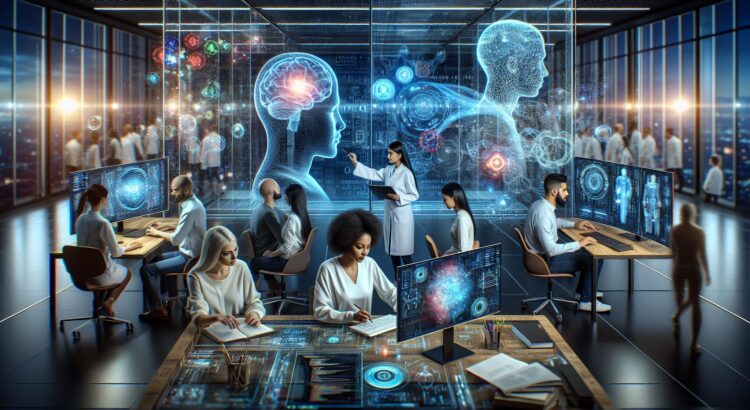
Artificial Intelligence is changing nearly every industry, from healthcare to finance. Today, we’re looking at a field where AI’s influence might be less obvious but just as transformative: the world of creative arts. Picture a future where artists and writers work alongside AI, using its power to not just improve their work but to create entirely new types of art. If you’re curious about how machines can work with human creativity instead of against it, you’re in the right place.
When Machines Started Making Art
The idea that machines can only do boring, computational tasks is quickly becoming outdated. AI has already shown it can write text, compose music, and even paint. While skeptics see artificial intelligence as a threat to creative jobs, I think we’re seeing something more like a modern Renaissance—an era where creativity gets a serious upgrade through human-machine collaboration.
Think about an AI-assisted novel where plot twists change in real-time based on what readers want, or a painting that shifts its style based on the artist’s mood. This isn’t science fiction anymore. These things are happening right now, creating new possibilities in creative arts that we’ve never seen before.
The Algorithm as a Muse
AI as a creative partner isn’t just theoretical—it’s happening. Algorithms can inspire artists who are stuck in creative ruts. Machine learning models understand what makes art connect with people. They can create first drafts or suggest edits, freeing up creators to focus on what makes them uniquely human: intuition, empathy, and emotion.
Take OpenAI’s GPT series. It shows how machines can write compelling stories or help with creative writing by suggesting phrases, plot developments, or character arcs. AI tools like DALL-E create visuals from descriptions, giving artists a whole new world of possibilities to explore.
New Tools for Storytelling
AI’s impact on storytelling is both disruptive and exciting. AI-powered platforms can create stories tailored to what each person likes. These systems analyze data, track what keeps users engaged, and adapt storylines in real-time for personalized content.
Filmmakers are jumping on this too. Software can now help with scriptwriting, editing, and post-production work, cutting down the time and money spent on these tasks. Visual effects powered by machine learning can bring imaginary worlds to life with incredible detail at a fraction of the usual cost.
Art Meets Science: The Role of Generative Adversarial Networks
One of the most impressive technologies driving this change is the Generative Adversarial Network (GAN). GANs have taken machine-generated art from abstract blobs to visually striking pieces. Artists like Mario Klingemann are already using these systems to create new forms of art that challenge how we think about aesthetics.
GANs work by having two neural networks compete—one creates artworks (the generator) and the other judges them (the discriminator). The result is an ongoing evolution that brings machine-generated art closer to human standards with each iteration.
Music Reimagined
In music, AI is pushing boundaries in composition, sound engineering, and audio production. Platforms like Amper Music or AIVA can generate entire compositions without human input, while musicians use AI tools to mix tracks or create synthetic vocals.
AI doesn’t replace musicians. Instead, it’s an incredible tool for amplifying creative expression. By analyzing thousands of compositions, AI can give musicians new approaches or instruments that help them develop their unique sound.
Challenges and Ethical Considerations
The opportunities are exciting, but integrating AI into the arts brings real challenges. Questions about intellectual property, artistic credit, and the blurred lines between human and machine-generated works complicate everything. We need ethical guidelines that evolve with the technology to make sure AI helps human creativity instead of hurting it.
Copyright and fair use laws need updates for a world where machines contribute to art. Artists should know where their input data comes from while being transparent about AI’s role in their creative process. Cultural bias in training data can lead to skewed or biased outputs, which means we need diverse datasets and inclusive programming.
AI as a Creative Partner: What’s Next?
As AI continues moving into creativity, we can expect entirely new forms and genres of art to emerge. These creative partnerships will challenge traditional ideas about authorship, redefine what it means to create, and give us new tools for self-expression.
Future developments might include AI systems that understand emotions through sentiment analysis, allowing collaborative pieces that aren’t just technically good but emotionally powerful. As more creators adopt these technologies, we’ll see boundary-breaking art that isn’t limited by human constraints.
Conclusion: A New Era of Human-Machine Creativity
The meeting of art and AI represents a major shift that’s less about replacing human creatives and more about improving the tools they have. By creating alongside AI, artists get access to expanding possibilities, inspiring new ideas, and redefining what’s possible in creative work.
In the next decade, we might not be able to tell which masterpieces were made by humans and which were co-created with machines. And maybe that won’t matter. In the combination of human intuition and machine precision, a new era of artistic expression is waiting.
As we stand at the edge of this creative change, the question isn’t whether AI will change the arts, but how it will improve them. Whether it’s a complex dance between code and brush stroke, or a partnership between pen and algorithm, the creative industry is ready to embrace an era where technology meets human ambition.
In a way, art is eternal. AI is just writing the next chapter of its story.