The Seductive Promise of Instantaneous Communication
Every few months, a breathless headline appears claiming scientists have achieved “quantum teleportation” or built a “quantum internet” that will revolutionize communication. The implication is always the same: we’re on the verge of instantaneous, faster-than-light communication that will make our current internet look like smoke signals. It’s an intoxicating idea that captures imaginations and spawns countless science fiction plots. Unfortunately, it’s also fundamentally misunderstood.

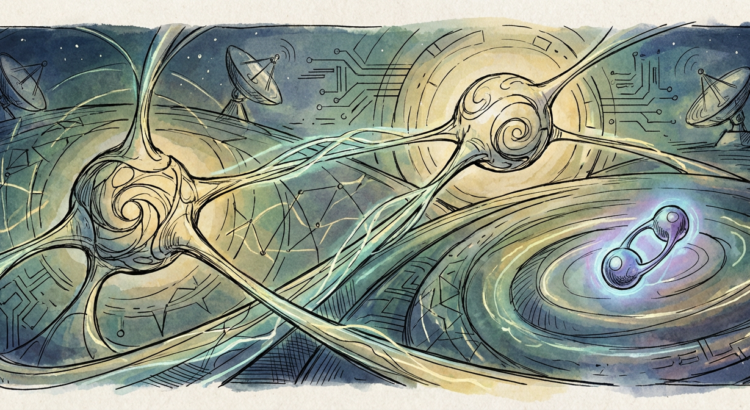
The confusion starts with a real quantum phenomenon called entanglement. Two particles become correlated in such a way that measuring one instantly affects the state of the other, regardless of the distance between them. Einstein famously called this “spooky action at a distance,” and his discomfort with the concept led to decades of debate about whether quantum mechanics was complete. When Alain Aspect’s experiments in the 1980s confirmed that entanglement was real, it seemed to open the door to science fiction becoming reality.
But here’s where the misconception takes root. While entanglement creates an instantaneous correlation between particles, it doesn’t actually transmit usable information faster than light. This distinction is crucial, yet it’s consistently overlooked in popular discussions about quantum communication. The result is a persistent myth that quantum entanglement will soon give us instantaneous communication across vast distances.

Why Entanglement Can’t Beat Einstein
To understand why quantum entanglement can’t transmit information faster than light, we need to examine what actually happens when entangled particles are measured. Imagine Alice and Bob each have one particle from an entangled pair. When Alice measures her particle and finds it spinning “up,” Bob’s particle will instantly be in the “down” state. This correlation is immediate and doesn’t diminish with distance.
Here’s the catch: Alice cannot control what result she gets when she measures her particle. Quantum mechanics tells us that the outcome is fundamentally random. Alice might measure “up” or “down” with equal probability, and there’s no way for her to force a particular result. This means she cannot encode a message by manipulating her measurements. Bob, observing his particle, will see a random sequence of “up” and “down” results that contains no information whatsoever.
The only way Bob can extract any meaningful information is if Alice sends him a classical message (limited by the speed of light) telling him which measurements she made and when. Only then can Bob compare his results with hers and see the correlation. The entanglement is real and instantaneous, but the information transfer still requires classical communication and is therefore limited by light speed.
This fundamental limitation is captured in the quantum no-communication theorem, which mathematically proves that entanglement alone cannot transmit information. It’s not a technical hurdle we’ll eventually overcome with better engineering. It’s a fundamental feature of how quantum mechanics works, as ironclad as the conservation of energy.
What Quantum Communication Systems Actually Promise
While quantum entanglement won’t give us faster-than-light communication, it does enable something potentially more valuable: absolutely secure communication. Quantum key distribution (QKD) systems use the peculiar properties of quantum mechanics to detect any attempt at eavesdropping. When a third party tries to intercept quantum-encrypted messages, the very act of measurement disturbs the quantum states in detectable ways.
Current QKD systems work over distances of hundreds of kilometers through fiber optic cables, and researchers have demonstrated satellite-based quantum communication over much greater distances. China’s Micius satellite, launched in 2016, has successfully distributed entangled photons between ground stations separated by over 1,200 kilometers. These achievements represent genuine technological breakthroughs, but they’re about security, not speed.
The quantum internet being developed by researchers worldwide will likely operate as a hybrid system. Classical information will still travel at light speed through conventional channels, while quantum channels will handle key distribution and enable new types of quantum computing applications. Networks of quantum computers could share entangled states to perform distributed quantum calculations that would be impossible with classical systems.
Perhaps most importantly, a mature quantum internet could enable quantum error correction across multiple physical locations. This distributed approach might finally make large-scale quantum computers practical by allowing them to share the burden of maintaining quantum coherence across multiple nodes.
Why This Misconception Persists and Matters
The faster-than-light communication myth persists partly because quantum mechanics is genuinely counterintuitive. Our everyday experience provides no framework for understanding phenomena like entanglement, superposition, or measurement-induced state collapse. When scientists describe entangled particles as “instantly” affecting each other across arbitrary distances, it’s natural for non-specialists to conclude that information travels instantly too.
Popular science communication often inadvertently reinforces these misconceptions by focusing on the most dramatic aspects of quantum phenomena while glossing over subtle but important limitations. Headlines about “quantum teleportation” rarely mention that only the quantum state is transferred, not matter or information, and that the process still requires classical communication to complete.
Science fiction has also played a role by popularizing the idea of instantaneous quantum communication as a plot device. While there’s nothing wrong with fictional technologies that violate physical laws, the line between entertainment and scientific possibility becomes blurred when real quantum research uses similar terminology.
This misconception matters because it can lead to unrealistic expectations about quantum technologies and misallocation of research funding. More fundamentally, it represents a missed opportunity to appreciate the genuinely remarkable capabilities that quantum communication systems do offer. Unbreakable encryption and distributed quantum computing are extraordinary achievements that deserve recognition on their own merits.
The Real Future of Quantum Communication
The actual trajectory of quantum communication research is remarkable enough without fictional embellishments. Teams around the world are steadily extending the range and reliability of quantum key distribution systems. The integration of quantum communication with existing internet infrastructure is progressing from laboratory demonstrations to practical deployments in financial institutions and government agencies.
Within the next decade, we’ll likely see quantum communication networks connecting major research institutions and enabling new forms of scientific collaboration. Quantum-secured communication links between banks and trading centers are already being tested. The European Quantum Communication Infrastructure initiative aims to deploy quantum communication technology across the continent by 2027.
Looking further ahead, space-based quantum communication networks could provide global quantum key distribution, making secure communication available anywhere on Earth. The combination of quantum communication with advances in quantum computing could enable applications we’re only beginning to imagine, from distributed quantum sensing networks to quantum-enhanced artificial intelligence systems.
Understanding what quantum communication can and cannot do helps us appreciate both the genuine achievements of researchers working in this field and the profound challenges they continue to face. The reality is complex, full of nuance, and ultimately more fascinating than the simplified myths. Have you encountered other misconceptions about quantum technologies? I’d love to hear about them and explore how the actual science compares to popular perceptions.